
Why England need to eradicate their 'freestyle' football before the World Cup begins

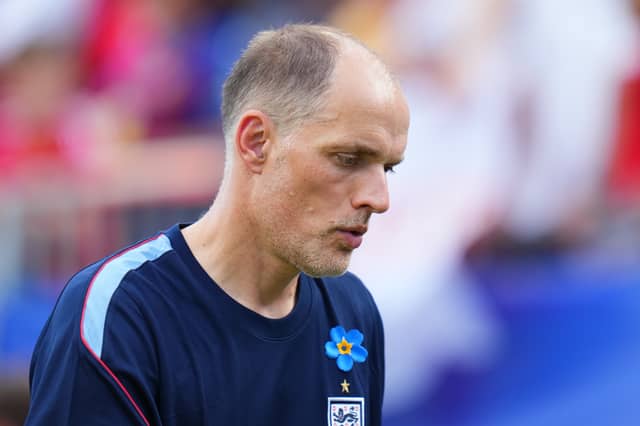

The performance and result against New Zealand didn’t matter - but the way that England seemed to ignore Thomas Tuchel’s tactics is a genuine concern.
England’s somewhat laboured performance against New Zealand on Saturday probably shouldn’t be the source of too much hand-wringing ahead of the World Cup. Nor should the narrowness of their eventual win, given that warm-up matches seldom resemble those played during the tournament itself. The “freestyle” football which frustrated Thomas Tuchel, however, might be a little more alarming.
“I’m not super happy about it,” the England head coach said when asked about his side’s performance. “The first half we were out of position and it was a bit too much freestyle… We were taking crosses, a lot of long-range shots, normally not our style of play. We played a lot of long balls, we played a lot of long passes. That was not part of training in the last four days.”
With a little over a week until the Three Lions begin their World Cup campaign against Croatia, England don’t seem to be playing football that aligns with Tuchel’s tactical vision. That, perhaps, is more worrying than England’s failure to score a few more goals in Tampa Bay.
Was England’s performance against New Zealand a worry ahead of the World Cup?
The two are correlated, of course. England managed 23 shots on goal against New Zealand but few of their opportunities could be described as clear-cut – they combined for the relatively lean total of 1.45xG. Keeping possession proved to be easy enough, but turning it into good chances was not so straightforward.
There were, as Tuchel observed, too many long balls, too many deep crosses and simply too many of the kind of low-percentage plays that aren’t meant to be in the playbook at all. Perhaps that was a reflection of tired legs and tired minds after several hard days in the draining Florida heat rather than being indicative of a deeper lack of strategic discipline, but it’s hard not to sense a pattern forming after the international break in March.
That drift from Tuchel’s tactical template was detectable in the 1-1 draw against Uruguay and the 1-0 defeat to Japan at Wembley, as well. Tuchel wants his England side to retain possession until they can carve open a good chance to shoot or play a killer ball, but instead there’s a growing sense of impatience, a refusal to play the simple pass when there’s a half-chance that a spectacular cross or long-range effort will come off instead.
The generous reading of this apparent tendency for Tuchel’s players to ignore his instructions and ideas is that it’s a function of players being overly keen to prove themselves and show off when there are places in the World Cup side on the line. The more problematic alternative explanation is that Tuchel is failing to get his ideas across effectively.
That would be surprising given the clarity with which he explains his thought process in media interviews, and the specificity with which he breaks down his decisions and tactical ideology. If he can explain his strategy in such a way that outsiders can readily grasp his plans, then one would imagine that his players are getting the message too.
“I like the second half more than the first half. We played more from our positions and that’s why we played with more speed and off the ball we played with a bit more bite,” he explained after Saturday’s game. “[The first half] slowed our game down and made it difficult for the counter-press, because we were not in the positions that we wanted to be when we started attacking. That’s basically the story of the match.”
Fitness was the focus - but Tuchel needs to get his team in order
In the squad’s defence, the game against New Zealand came less than a week after they began a Florida training camp which is designed to focus on helping the players to adapt to the demands of playing in 30-plus degree temperatures and stultifying humidity instead of fine tuning the football that they play. Endurance training has made up the majority of the players’ work so far, and Tuchel’s team played just one full training game together before travelling to Tampa Bay.
The decision to play two different teams in each half also stunted the flow of the match, and Tuchel conceded that the conditions – the thermometer hit 32° at the Raymond James Stadium - and the rotation of his players made the game feel “really, really odd.”
But the failure to find any kind of flow against a New Zealand side that are the lowest-ranked in the World Cup and that shipped four goals against Haiti in their first warm-up match is still going to set a few teeth on edge. The result may not have mattered and building fitness may have been the only real goal, but if England aren’t playing the way that their manager wants then it’s reasonable to become a little nervous about what comes next. It’s one thing to look sluggish and out of sorts, another to fail to follow the head coach’s instructions altogether.
Perhaps, by the time that England face Croatia in Texas on 17 June, the players will be suitably acclimated and the disconnect between Tuchel’s ideas and the decisions made by his players will have disappeared. There is another friendly to come, against Costa Rica in Orlando on Wednesday, and another week or more of warm-weather training. Everything could look a little bit sharper after that.
The Gareth Southgate era often demonstrated the gulf between friendly games and major tournaments, and provided plenty of evidence to support the idea that a somewhat lacklustre display against a New Zealand, a Uruguay or a Japan had little bearing on how the side would play when it truly mattered. Saturday’s match isn’t too worrying in its own right – but Southgate also had the players singing from his hymn sheet for most of his tenure. Tuchel needs to get the choir in tune before they play Croatia.