
Is Chelsea's Liam Delap England's only hope after Harry Kane? What defeat to Japan taught us about the future

England’s defeat to Japan provided a bleak insight into a future without Harry Kane - but is Chelsea’s Liam Delap really the Three Lions’ only hope?
The FA billed England’s March friendlies against Uruguay and Japan as the ‘Send-Off Series’. What Thomas Tuchel and his squad have been sent off with is a draw, a defeat, and a sense of impending doom and gloom – and a lot of the fretting has focused on just how poor England appeared to be without Harry Kane.
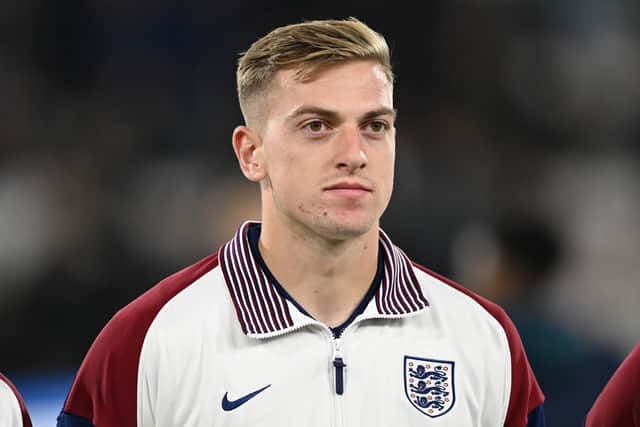

The general wailing and gnashing of teeth has probably been a little excessive. The Southgate era frequently demonstrated the gulf between friendlies and tournament matches, and poor performances by a weary, semi-experimental team in the former do necessarily not beget difficulties in the latter. Tuchel won’t have enjoyed what he saw and it would have been good to see any of the players auditioning for the squad stake a claim (they didn’t) but the Japan game was scarcely a loss worth getting in a lather over.
But the concern over Kane’s absence – and how badly England’s chances at the World Cup and beyond may be impacted by an injury or his eventual decline – is certainly a valid point of discussion. England looked utterly toothless against a disciplined Japanese defence at Wembley. England need a Plan B for this summer, and a succession plan for summers yet to come. Could Liam Delap be the answer England are looking for?
Is Liam Delap England’s only hope for the post-Kane era?
Let’s start with the good news: While the exact nature of Kane’s injury remains undisclosed at the time of writing, there are currently no indications that it’s serious or that his participation in the World Cup is in any particular doubt. He doesn’t seem to be following David Beckham and Wayne Rooney in joining the tradition of cracking a metatarsal before a major tournament.
But the blunt truth is that Kane is now 32, and can only keep going on for so long. Sports science may be creating an age of minor miracles, but for every Robert Lewandowski who seems impervious to the effects of ageing, there is a Mohammed Salah to demonstrate that time can still catch up with the greats quite suddenly.
Kane may well be good for another Euros, perhaps even the 2030 World Cup, but the time is coming when England need to think about what comes next – and the blunt truth is that the only English striker who will be under the age of 30 when the next World Cup rolls around with any semblance of a track record in the Premier League is Liam Delap. Given his form for Chelsea this season, that inspires little confidence.
Delap may well turn things around, but the uniqueness of his position is the true concern. Journalist Henry Winter, bemoaning England’s lack of alternatives to Kane after Tuesday night’s rather dismal defeat, suggested that FA coaches “debate why there are so few [number nines] emerging,” but in truth those coaches know the answer. It’s a global problem, not an English issue.
For years now, the wider tactical direction of football has encouraged academies to nudge any young up-and-comer with evident attacking flair and nascent technique towards the wings. Look at the next generation of young English talent coming through the ranks: Max Dowman, Rio Ngumoha, JJ Gabriel… All wingers. Once, such gifted players would have been turned into strikers, but it has been years since that position has been prioritised at academy level.
It’s the same for most countries. Yes, there is the occasional Erling Haaland whose physical attributes push them towards the number nine role from a young age, but the direction of travel in the game as a whole has been to focus natural goalscoring talent in wider areas. England’s paucity of ‘true’ striking options is a problem faced by most international sides.
Which is why we end up with a situation in which England have an embarrassment of riches in terms of young talent in most outfield positions, but only one young centre-forward worth discussing. And Delap is a man well out of form, playing at a club who seem uncertain of how to best use him.
Given that Delap has scored just one Premier League goal for Chelsea in the past eight months, it’s very difficult to make any kind of case to take Delap to North American in June, not least because his style of play has a more experienced analogue in Ollie Watkins – not a player having the best season himself, admittedly, but one who has proven that he can stretch defences in tight matches with good effect. Just ask the Netherlands how dangerous he can be.
After the World Cup, however, there is perhaps a strong case for integrating Delap regardless of whether he remains at Chelsea or whether he starts finding his scoring touch again. One day, he may well be England’s best number nine, if only by default, and having him around the squad, learning how to link up with the other young attacking players around him like Bukayo Saka, Cole Palmer and Jude Bellingham, could pay dividends in the long run when Kane’s time finally comes. After all, the other strikers in the reckoning for caps right now are getting a little long in the tooth as well. Few if any of them will be serious considerations in 2030.
There are a few other youngsters coming through who may eventually surpass Delap, but only a few – Leeds United’s Harry Gray, a 17-year-old currently on loan with League One Rotherham United, is generating a fair amount of hype, for instance. But Delap is the only striker a healthy distance south of 30 who has been tested at the top level without wilting entirely.
Delap needs, as Winter suggested, to “get the upward trajectory of his career back on track again.” That may mean leaving Stamford Bridge prematurely. If he can find a club, in England or overseas, which makes proper use of his talents – his aggressive willingness to attack the channels, that mythologised ‘half a yard of pace’ – then it could be good not only for himself but for England going forward. None of that, however, will help Tuchel this summer.
How worried do England fans need to be if Harry Kane misses the World Cup?
Let’s assume, for a moment, the worst: That Kane’s injury is more significant than initial reports have suggested, or that he sustains some other debilitating fitness issue between now and the opening match against Croatia on 17 June. Just how bad would that be for England?
Based on the performance against Japan, pretty bad – but that performance has to be placed into the context of the other players who were absent. There was no Bukayo Saka, who can shred low blocks when at his best. No Declan Rice, whose driving runs from midfield have created so many chances. No Jude Bellingham, who breaks defensive lines apart with insouciant ease – and who, lest we forget, did a very good impression of a centre-forward for Real Madrid in the 2023/24 season.
So did England’s defeat at Wembley tell us that they are toothless without Kane, or did it also speak to the importance of several other players in the squad? Did it tell us that England can’t cope without their best striker, or simply that Phil Foden as a false nine probably isn’t the answer?
Clearly, losing Kane, by far England’s best natural goalscorer and a man with a lifelong habit of turning water into wine inside the penalty area, would be awful news – but there are other goalscoring threats who will (fitness permitting) be in the team to face Croatia and who might pick up more of the slack than they are given credit for.
The biggest issue is that none of the potential analogues for Kane have made much of a case for inclusion in the final 26-man squad. Dominic Solanke is a very decent traditional number nine, but has had a turgid, injury-ridden season with a struggling Spurs side and didn’t look especially sharp in the March internationals. Dominic Calvert-Lewin, meanwhile, found a brief run of form for Leeds only to see that resurgence sputter out. He has scored just one goal in his last 11 games, and missed a glaring chance against Uruguay.
Which suggests that England’s Plan B for a Kane-free world needs to revolve not around replacing him directly, but rethinking the strategy entirely. Playing a false nine and having the wingers push up behind them might work (Foden failing to make a dent in the same role doesn’t prove that Bellingham, for instance, couldn’t do it). Reimaging the system to play Watkins – or, indeed Delap – in behind might be better than just trying to shoehorn a Solanke or a Calvert-Lewin in, too.
And if England do one day find themselves without a clear-cut replacement for Kane when the time comes, it doesn’t spell the end. There will be attacking talent in abundance, it will just require a manager with the tactical nous to work out how to refocus the system on the wingers rather than the central striker. Number nines are a dying breed, and by the time Kane’s number is up, there will be innovations which render it less problematic.
England need Kane now, but a future without him isn’t necessarily disastrous. They may need to bring Delap in at some point to give him a chance to establish himself as a key future contributor, but that moment isn’t now – and it’s unlikely, in reality, that there won’t be other options in four years’ time if a 36-year-old Kane is indeed too far past his best to play in the multi-national World Cup.
In short: Don’t panic. That Japan match wasn’t a death knell. All it told us was that England’s back-ups aren’t ready to displace their best starters, and that an England side shorn of most of its core attacking pieces wouldn’t be able to compete over the summer. Fortunately, most or all of them should be in place come the middle of June. Fingers crossed…