
The longest bans in Premier League history after Chelsea’s Mudryk was suspended for four years

The 10 longest suspensions in the history of the Premier League after Mykhaylo Mudryk’s record-breaking ban.
Chelsea winger Mykhaylo Mudryk has been handed a four-year ban from The FA after returning an adverse sample in a doping test – and as such has received one of the longest suspensions in the entire history of the English game.
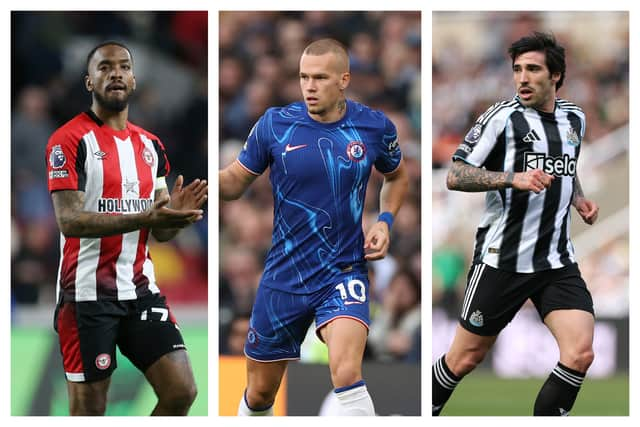
Mudryk, who has protested his innocence, is appealing the ruling with the Court of Arbitration for Sport, but as it stands he’s set to be unable to play until 2028 with the start of his ban backdated to the beginning of a provisional suspensions which was handed down in November 2024 – but where does he rank among the lengthiest suspensions in Premier League history? We’ve got the Top 10 below…
10. Kolo Touré – Manchester City (6 months)
The Ivorian centre-back had joined his brother Yaya at Manchester City in the summer of 2010, only to have his debut season at the Etihad prematurely curtailed when a drugs test found that he had taken bendroflumethiazide, a substance used to aid weight loss.
The FA eventually accepted Touré’s argument that he had taken the substance – found in his wife’s slimming tablets – for aesthetic purposes rather than to gain a competitive advantage, with his legal team suggesting that Touré suffered from a "misplaced perception that he was fat.” He still served a six-month suspension, missed the FA Cup final, and copped a fine of six weeks’ wages from his new club. He was back in action by September 2011, his reputation largely untarnished by the affair.
It’s worth adding that Vinnie Jones also got a six-month ban in 1992 for bringing the game into disrepute after presenting a compilation video called ‘Soccer’s Hard Men,’ a seemingly innocuous act which didn’t well so close to football hooliganism’s heyday. That ban was suspended, however, so we’re giving Touré tenth place outright.
9. Adrian Mutu – Chelsea (7 months)
Mudryk is far from the first Chelsea player to have copped a ban for taking something he shouldn’t have. Back in 2005, Romanian forward Mutu tested positive for cocaine and was handed a seven-month ban by the FA. That, however, was arguably the least of Mutu’s troubles after the verdict was handed down.
Chelsea, seeking to get their money back after signing a player who had looked like an expensive flop even before it turned out that he’d been taking illegal drugs, successfully sued Mutu in 2010 for over €17m (around £15m at the time), a verdict that was upheld despite multiple appeals. It’s not clear how much he ever actually paid.
=8. Rio Ferdinand – Manchester United (8 months)
England defender and seemingly omnipresent TV personality Ferdinand was just entering his prime at Old Trafford when he missed a scheduled drugs test at Carrington – claiming that he had forgotten about it and popped down to the shops for a bit of retail therapy. It wasn’t an excuse the FA were in any mood to accept.
Ferdinand did subsequently pass a drugs test, but the damage was done. He was suspended for eight months, and missed Euro 2004 as a result. England still had John Terry and Sol Campbell around, admittedly, so that probably wasn’t the reason that they were knocked out on penalties by Portugal.
=8. Ivan Toney – Brentford (8 months)
Toney was banned in 2023 after admitting a staggering 232 breaches of the FA’s gambling rules having placed bets consistently across his career – including betting against his own team while he was a youngster at Newcastle, although he didn’t bet on games in which he himself played.
The striker could have faced a much lengthier suspension but it was eventually held to just eight months as he had been diagnosed with a gambling addiction. Toney scored on his first game back for Brentford in January 2024 and soon made a big-money move to Saudi Arabian side Al Ahli.
=6. Mark Bosnich – Chelsea (8 months)
Mutu wasn’t even the first Chelsea player to have an unfortunate run-in with white powder. While the Blues don’t appear to have tried to sue Bosnich into fiscal oblivion in the aftermath, they did sack the Australian goalkeeper after he tested positive for cocaine in 2002.
It would prove to be the end of Bosnich’s career at the top level and he spiralled down into an addiction which reportedly cost him thousands a week and saw him take up to 10g of the drug a day – a colossal amount. Happily, he eventually recovered and played a few more matches in Australia several years after leaving Stamford Bridge, and is now a pundit.
=6. Eric Cantona – Manchester United (8 months)
You’ve all seen this one. Perhaps the most infamous act of violence ever committed at a Premier League match took place in January 1995, when Cantona, riled up by a Crystal Palace fan following a red card at Selhurst Park, lunged studs-first into the stands to ‘kung-fu kick’ the supporter in the chest.
Not only did Cantona get an eight-month ban, but he also got 120 hours of community service after being convicted of assault. Court proceedings provided one of the least believable claims in British legal history: Cantona said that the fan he kicked had called him a “French b**tard” but the victim of the assault insisted that he had merely shouted “It’s an early bath for you, Mr. Cantona!” – an assertion that surely wouldn’t have stood up to analysis from a lip-reading expert.
4. Sandro Tonali – Newcastle United (10 months)
Not long after Toney was banned for gambling offences, Newcastle midfielder Tonali followed him into exile, receiving a 10-month suspension for betting on AC Milan matches while he was at the San Siro. The ban came just months after the Magpies had spent a hefty £55m for the Italian.
Tonali would later reveal that he had picked up a gambling habit as a teenager which had developed into an addiction over time – Newcastle stood by their man and were rewarded with some fine performances once he returned to action in August 2024
3. Abel Xavier – Middlesbrough (one year)
The Portuguese full-back, something of a cult figure for his distinctive bleached hair and beard, became the first Premier League player ever to be banned for using performance enhancing drugs back in 2005 after he was caught using anabolic steroids.
Initially banned for 18 months, he later got his sentence reduced to a year on appeal and remained at Middlesbrough, who kept him on after his ban. Still, Xavier had made an unwanted piece of history as the league’s first ever drugs cheat – and yes, in case you’re wondering, he still has the hair.
2. Joey Barton – Burnley (13 months)
Were we to list every single ban, suspension and criminal sentence that Barton had ever received over the years, we’d be here all day. Sufficed to say that it’s not exactly a shock that one of most controversial people ever to play the game of football held the record for the Premier League’s longest ban for many years.
Like Toney and Tonali later, Barton’s lengthiest suspension was for gambling. In 2017, Barton – then at Burnley - was found guilty of placing a breath-taking 1,260 separate bets over the course of his career, and handed an 18-month ban which was reduced to 13 months on appeal. It effectively ended his professional career and forced him into the world of management instead.
1. Mykhaylo Mudryk – Chelsea (four years)
Mudryk’s four-year ban, the maximum that the FA could inflict on him, is the longest ever handed down to a Premier League player, by an absolute mile – and even if the verdict gets overturned on appeal, his provisional suspension will already have seen him sit out for longer than Barton.
It isn’t quite the longest ban in top-flight history, however. In 1915, eight Manchester United and Liverpool players were given lifetime bans for match fixing, and while seven of them had their bans withdrawn after agreeing to enlist for World War One, one player – United forward Enoch West – refused to fight. He ended up being banned for 30 years, until his suspension was officially overturned by the FA in 1945, by which time he was 59 years old. Better, however, than going to the trenches.