
Boardroom changes and a total squad overhaul: what Leicester City must to do this summer

Leicester City’s relegation to League One may not be as bad as it gets - we look at what Leicester need to do to turn things around.
Just a decade on since winning the most improbable Premier League title, Leicester City have been relegated to the third tier, their fate confirmed by a 2-2 home draw against Hull – the Foxes’ seventh consecutive match without a win. The only question now is whether this is a car crash that has reached its conclusion, or whether things could get even worse.
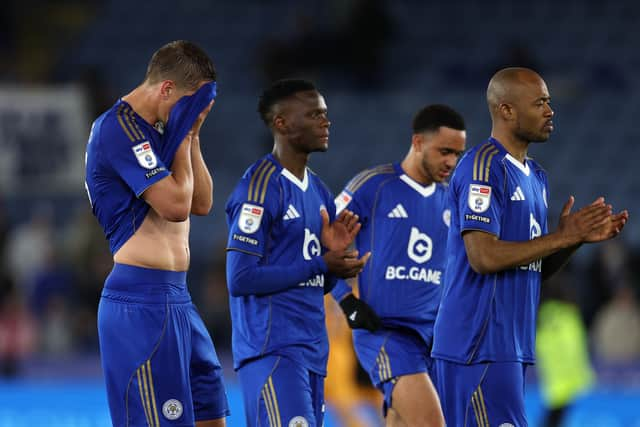

Failures of financial management and recruitment over the course of several years mean that Leicester will plunge into League One with a desperate economic situation and a squad full of expensive, underperforming players that they need to somehow sell. Supporters, meanwhile, are calling for the heads of many members of the board. Can the club get out of the mire and turn things around?
The challenges facing relegated Leicester on and off the pitch
Looking at Leicester’s squad on paper, it’s easy to wonder how things got this bad in the second tier. The team has both experience and talent, at least in theory. Pick out just about any of their many big-name players, however, and ask the fans about how well they’ve been playing. Be prepared to hear some choice language.
For years now, Leicester have recruited the wrong players, at the wrong time, and spent too much to do so. Worse still, they have failed to find buyers for those underperforming purchases down the line. That’s why they found themselves in the Championship with players like Patson Daka still on the books on reported wages of £75,000 per week.
Leicester’s wage bill, estimated by Capology to stand at just over £820,000 per week, is more than a third higher than that of any other team in the division – a figure which puts the scale of their failure into stark perspective.
This isn’t just a case of a series of investments failing to pay off on the pitch, however. Leicester have overspent badly in both the first and second tiers over the past several seasons, sustaining an operating loss of £20.8m for the 2023/24 season, which led to a six-point deduction in the Championship this year, and £71.1m for 2024/25 despite being in the Premier League. That could mean another deduction to start life in League One if the top flight’s profit and sustainability rules are proven to have been breached, although that is far from confirmed.
The long and short of it is that Leicester have grossly and continuously overspent in the process of building an extremely poor squad. One can find excuses for some of their failures of recruitment – could anyone really have predicted the extent to which Harry Winks and Oliver Skipp would fall away, for instance? – but they have not moved let-downs on, have allowed ageing strugglers to stay on high contracts, and have not made anywhere near enough good signings to make up for the bad.
The club’s supporters have, quite reasonably, levelled the blame at the board, particularly chief football officer Jon Rudkin, who was director of football when they won the Premier League, and owner Khun Aiyawatt 'Top' Srivaddhanaprabha, who took over in 2018 following the tragic passing of his father, Khun Vichai Srivaddhanaprabha, who died when his helicopter crashed outside the King Power Stadium. Both Rudkin and Top Srivaddhanaprabha have, bluntly, appeared out of their depth in their new roles.
Changes in the boardroom may be a necessity, and Top Srivaddhanaprabha will need to find a ruthless streak which he has perhaps lacked in his decision making thus far. Leicester’s owner has been willing to bankroll the clubs losses and may well continue to do so, but the club has also borrowed heavily against future instalments due on transfers, pushing them further into a financial corner.
Whoever makes the calls this summer – and few fans would be happy if Rudkin continued to be involved in that capacity – the first order of business will be doing everything possible to balance the books. That will be tricky heading into League One, where clubs will only be allowed to spend 60% of their transfer proceeds on wages and fees, with a bloated wage bill.
Can Leicester reshape their squad successfully this summer?
Headed into the first campaign in the third tier since the 2008/09 season, the biggest problem for Leicester isn’t so much finding new players as it is getting rid of those already on the books. The income available in League One is simply incompatible with the salaries of almost every player in the squad.
Seven first-team players have contracts which expire this summer, including Daka along with Jamaal Lascelles, Asmir Begović, Jordan Ayew and Ricardo Pereira, all the wrong side of 30 and looking withered by age and injury. Their departures, all inevitable, will be a relief rather than a worry.
That still leaves all too many highly-paid players on the books, many of whom will be hard to shift. It’s difficult, for instance, to envisage many suitors circling Jannik Vestergaard or Bobby De Cordova-Reid, both 33 and coming off bad years. Agreeing mutual terminations of their deals and minimising the loss may be the best way forward.
There may be interest in the likes of Caleb Okoli and Abdul Fatawu, even if the latter looks diminished after missing most of the 2024/25 campaign with a ruptured ACL. Someone can probably be persuaded to take a chance on the frustrating but talented Stephy Mavididi, and there will no doubt be interest in 16-year-old winger Jeremy Monga, although Leicester won’t get much of a fee given his age and the fact that he isn’t eligible to sign a professional contract until July.
In short, there are few saleable assets and little chance that such sales will cover the club’s operating losses. That will leave a very slim volume of breathing room for recruiting new players, and it’s hard to predict what the squad will look like come August. There will certainly be a considerable amount of churn, but that is no bad thing – the more familiar faces there are at the King Power Stadium, the more money that Leicester are spending when they can ill afford to.
The first priority has to be balancing the books and getting closer to a sustainable footing. That’s unlikely to be possible in one summer, and may be a long and painful process – and even if everything is done correctly here on out, there could easily be more financial losses, more points deductions, and perhaps even another relegation. It isn’t unthinkable that Leicester follow Portsmouth and Bradford from top tier to League Two given that there is no way to predict how strong of a side they might be able to field.
The best case scenario is that Top Srivaddhanaprabha continues to willingly bankroll the club’s losses, that he appoints executives who can balance the books and finds people who can identify talent more effectively than those who have done so over the past two years, both on the pitch and in the dugout. There have been too many missteps in terms of managerial appointments, too.
Nothing less than a complete reversal of the club’s boardroom culture is necessary to turn Leicester around, while a complete overhaul of the squad is less of a good idea than an absolute economical necessity. This will be a very difficult summer, with very few easy calls involved. Get too many of them wrong, however, and a spell in League One may not where the freefall bottoms out.