
Brian Brobbey has the firepower to send Sunderland into Europe - if they're ready to take some risks

Sunderland need to score more goals to qualify for Europe this season - but Brian Brobbey can do the job if they’re prepared to become more adventurous.
In spite of the 5-0 thumping they took at the hands of Nottingham Forest last Friday, Sunderland head into the weekend firmly in contention for the European places. Their ability to get there, though, may depend on whether they can find an answer to a question that has troubled them all season: How to get the best out of Brian Brobbey.
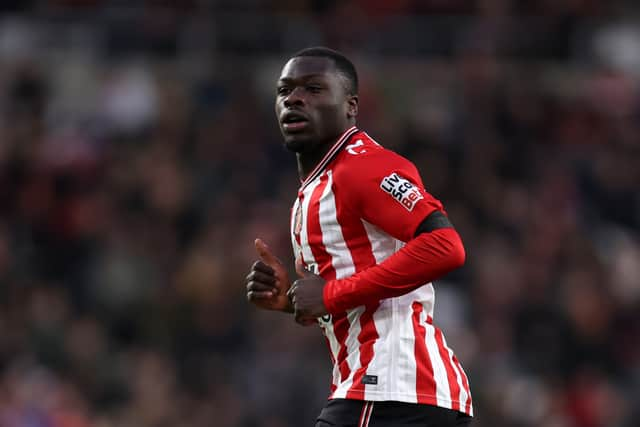

The Dutchman has certainly looked like Sunderland’s best centre-forward since signing from Ajax last summer, but his production has been modest – just six goals in 27 Premier League appearances. Unlocking him may be a necessity if Sunderland are to qualify for continental football. So why hasn’t he hit the back of the net all that often despite passing the eye test? And what can Sunderland do to flip the script?
Why Brian Brobbey has struggled to score despite looking the part
On the surface, the numbers don’t make for particularly pleasant reading. Since a purple patch in January, Brobbey has just one goal in over three months – the winner that he bundled home at St. James’ Park.
His performance in the recent 1-0 win over Tottenham Hotspur, when he passed up two fine chances from close range, won’t have helped his confidence, and he’s managed to rustle up the sum total of just one shot on goal in two games since. He is simultaneously Sunderland’s greatest individual threat and a player who is struggling to score.
A deeper rummage into the stats, however, suggests that the headline numbers don’t tell the whole story. Brobbey may only have six league goals to his name this season, but he’s scored them from just 4.47xG – a conversion rate that most Premier League forwards would envy. He has also scored with an impressive 22% of his attempts. Only nine players with at least 20 shots at goal to their name have been more precise in the top flight.
Brobbey has been an efficient finisher as well as a pugnacious physical presence up front. The problem is that he simply isn’t being supplied with enough chances. Fix that, and Sunderland may not need to worry about finding another striker this summer to maintain their momentum.
Sunderland’s combined expected goals total of 37.36 is ahead of only Wolves and Burnley, as is their 115 shots on target in 34 games. The Black Cats have the striker they need, if the relatively small sample size behind Brobbey’s stats can be believed – what they lack is the creativity to back him up.
Sunderland have comparatively little quality behind Brobbey in the final third, an issue that can’t be addressed between now and the end of the season, but the club’s lack of spark in attack isn’t solely a consequence of their personnel but also their tactics. So what can Régis Le Bris do to find new routes to goal over the course of the final four games of the season?
What can Sunderland change to start scoring more goals?
While Le Bris has been flexible with his tactics over the course of the season and has chopped and changed his methods from one match to the next, two things have been more or less constant – Sunderland have been more compact than most teams, and have lacked width in the final third.
The lack of a natural number 10, combined with a conservative assessment of the reality of playing as a newly-promoted side in the Premier League, means that the compactness of Sunderland’s formation has been entirely sensible to this point. It’s a substantial part of the reason that they’re even in the European conversation. It may also be something they need to discard for a little while.
By playing with a relatively deep defensive line, especially when leading games, and by having Granit Xhaka and Noah Sadiki take up primarily shielding roles with Habib Diarra operating in a more advanced position ahead of them, Sunderland have generally been able to keep opponents at arm’s length and have protected the centre of the field well. They’ve also been guilty of getting bogged down in deeper areas, however, making it harder to get quick balls forward.
Without players who can break defensive lines on the run, Sunderland have primarily looked to advance by playing balls into spaces between the opposing back line and their midfield – a reasonable ideology given their squad, but because the midfield and full-backs are often coming from deep starting positions, they struggle to get forward in numbers quickly enough to exploit many of the promising positions they find themselves in.
That can be ameliorated with more aggressive midfield and full-back positioning, and perhaps the use of Enzo Le Fée as a number 10 rather than as a left winger – the Frenchman has the cutting edge and ability to play incisive second balls that most of Sunderland’s other options in that part of the field lack. With wide players Jocelin Ta Bi, Romain Mundle and Nilson Angulo all looking to return from injury over the coming weeks, redeploying Le Fée may be more feasible, too.
Such a move would strip them of some of the defensive protection that they have thrived upon, but with relegation out of the question and a European place as a potential prize, there is little reason not to dispense with caution so long as it’s done judiciously. Sunderland’s league position gives them license to be bolder now that they have already achieved their pre-season goal of survival. There is little to lose and much to be gained.
Pushing the wing-backs forward would also offer some of the width and variety up front that has been absent for some time. Sunderland have often used Brobbey’s strength to put him at the point of passing triangles in attack, but with width from the wing-backs, Sunderland could use his hold-up play more effectively by getting players like Le Fée and Chemsdine Talbi closer to him.
Get the full-backs into advanced areas and it gives defenders a choice – go wide to track them, and create channels into which Brobbey or his comrades can run, or stay narrow and allow the full-backs to swing balls into the box. Brobbey isn’t an especially tall striker, but is good with his head and has a burst of acceleration that helps him to attack low crosses. We haven’t seen that often enough since he was signed – only Burnley have attempted fewer crosses than Sunderland’s 104 this season.
Attacking with width and pace has also been an effective way to beat Wolves, this weekend’s opposition, with their 3-4-3 system often leaving space in behind the wing-backs. Le Bris might not care to be too gung-ho against Manchester United or Chelsea, two of their other remaining opponents, but both sides can be placed under pressure and pushed back by teams that are willing to play higher lines and to try and peg them back. Despite their quality, neither of those sides has been particularly ruthless when it comes to punishing aggressive defensive positioning.
Even after that dismal evening against Nottingham Forest, Sunderland are still only three points behind seventh place – and thanks to the vagaries of European qualification, it’s possible that a team as low as ninth could make it into continental competition. And while their form hasn’t been superb of late, that’s also true of all the other mid-table teams currently tucked in behind Brighton and Bournemouth.
Of the four sides immediately ahead of them in the table, only Fulham have more points in their last five matches. A place in Europe isn’t all that far away – but Sunderland may have to be more aggressive, and to player wider and further up the pitch, in order to seize the opportunity and to give Brobbey the kind of service he needs to fire Sunderland towards what would be a remarkable achievement.
The Dutchman has the burst of speed required to attack balls in behind the defence, the physicality and aerial quality to put crosses away, and the link-up skills to provide chances for others when there is space to play them in. Sunderland’s tactics to date have limited his ability to exploit those attributes.
That relatively conservative playing style has worked out well enough so far, and playing against type and trying to be more adventurous in the opposing half could easily backfire. Or it could bring Brobbey’s quality in front of goal to the fore and pay off. After all, just what is there to lose?