
Thomas Frank was a failure - but Tottenham Hotspur's board must take their share of the blame

Thomas Frank has been sacked after a desperately poor season - but was he the only reason that Spurs are struggling?
It feels like a very long time ago now, but Thomas Frank began his ill-starred tenure as Tottenham Hotspur manager with four wins in his first five matches. For a short while, everything looked rather rosy in North London. It didn’t last.
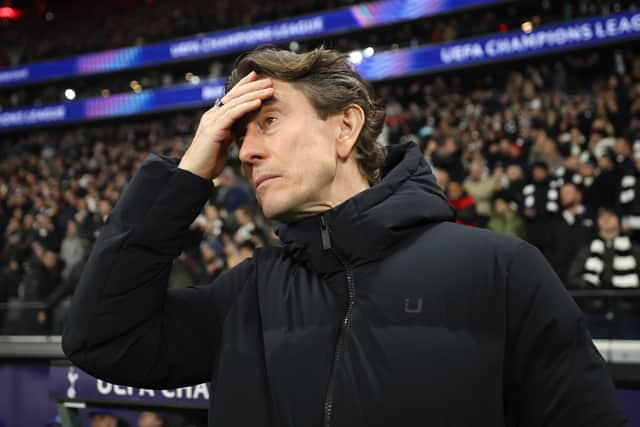

Spurs have now sacked Frank after eight months in charge, and he ends his spell with the club having averaged just 1.12 points per game in the Premier League, the lowest mark set by any manager who led Spurs in at least five games in the competition. He didn’t win any of his last eight league matches in charge. There wasn’t a very strong case to keep him on any longer – the situation was becoming rather dire.
Frank had precious little luck and had to endure the worst injury situation of any club in the top flight by far, but still failed. But where did the Dane, who was so impressive at Brentford, go wrong? And how much of the blame for a season which is teetering on the brink of disaster has to be placed at the feet of the Spurs board rather than those of their outgoing head coach?
Why Thomas Frank failed as Tottenham Hotspur manager
Frank leaves Spurs with the club just two places and five points above the relegation zone – an inconceivable position for one of the Premier League’s wealthiest clubs, a supposed member of the ‘big six’ and a team which has spent an estimated £230m on transfers since the end of last season. Whatever excuses might be made for Frank, he still failed spectacularly.
The former Brentford manager failed, first and foremost, to do what he did with his old club – to inculcate a clear tactical identity and style of play. With Brentford he tweaked his tactics over time, but the underlying methodology was both clear and consistent. At Spurs, it was all something of a mess.
Frank seemed unable to decide whether to set his Spurs side up to play on the counter-attack or to control possession. He chopped and changed personnel and formation and never seemed to settle on a particular ideology.
Take the embarrassing 4-1 North London Derby defeat back in November, when Frank suddenly switched to a back three – not only did that decision effectively concede the midfield to Arsenal, but few of his players looked like they had a clear idea of what their role in the new 3-4-3 formation was meant to be. Positionally, Spurs were a mess, and were picked apart before being finished off by Eberechi Eze’s hat-trick, with the goals all far too easy as players lost track of their man and donated swathes of space around the penalty area.
Prior to that game, Frank had mostly utilised a 4-2-3-1 system. Immediately afterwards, he dabbled with a chaotic 4-2-2-2 which was entertaining but ultimately unsuccessful. By the time the final curtain came down with a 2-1 home defeat to Newcastle United, Spurs were lining up in a 4-3-3. Frank, a manager who had seemed so solid and coherent at his former club, had made a complete mess of things.
The laundry list of injuries provide a partial excuse, and a very decent one at that, but many of the changes of style and system were not enforced. Nor was he always compelled to rotate to the extent that he did – players like summer signing Xavi Simons and the talented but wayward Mathys Tel were in and out of the team, playing in different positions from one week to the next, and never given the best chance to find their feet.
As head coach, the buck for his players’ performances ultimately stopped with him, and he failed to get the best out of many members of his squad who have proven ability which outstripped their eventual production. Too many players seemed uncertain of how Frank wanted them to play, of how to link up with their team-mates, or simply of how to position themselves in relation to the broader formation.
Quite why Frank, a manager who seemed to understand the importance of a clear philosophy at Brentford, ended up making such of a meal of his tactics and coaching is unclear – but his failings in that department are surely not the only reason that Spurs have found themselves in such a deep hole.
Spurs’ problems run far deeper than Frank
With Frank leaving Spurs on the cusp of a relegation battle, he now becomes the second consecutive manager to depart the Tottenham Hotspur Stadium with the club perched just above the bottom three. Spurs finished 17th under Ange Postecoglou just last season, after all.
When two head coaches in succession struggle so badly in the league, it strongly implies that the appointments themselves were not the only problem, but the tools with which they were expected to operate.
Given their prior achievements, it is difficult to imagine that both Frank and Postecoglou are simply bad managers. They may have been bad fits for the club, and certainly designed a fair portion of the architecture of their respective downfalls, but their failings only represent the sharp end of a steady decline which has been going on since the controversial decision to sack Mauricio Pochettino back in 2019.
In the intervening years, several managers – each with wildly differing playing styles and philosophies, ranging from the conservatism of Antonio Conte and José Mourinho to Postecoglou’s ultra-aggressive high-pressing system – have come, gone, and ultimately failed to clear the bar set by the owners’ ambitions and the club’s financial standing.
While Frank failed to nail down an overarching concept for the kind of side that Spurs needed to be, the board have done the same. The current squad is a curious mixture of players suited to different systems and schemes, a blend of experience and inexperience, of players who function at their best in differing set-ups.
Spurs have signed the wrong players far too often, and spent considerable sums in the process – all while failing to address problem positions. Postecoglou spent much of his reign desperate for a midfield refresh and never got one, and the position wasn’t touched until the arrival of Conor Gallagher in January. Too little, too late.
Then there’s the centre-forward position – Dominic Solanke, Randal Kolo Muani and Richarlison are all very different players and swapping one out for another between games or in the middle of them isn’t a matter of making plug-and-play changes. There has been an overriding lack of consistency in when and how Spurs have invested in the playing squad. Perhaps it’s no wonder that Frank couldn’t puzzle out how he wanted his team to play.
It won’t have helped Frank that Gallagher was the only truly senior player signed for the first team squad over the winter, and Cristian Romero was right to decry the lack of activity by a side which had the resources and the PSR headroom to make significant changes to a squad which was sinking slowly towards the bottom three. In the summer, Spurs were busy but didn’t address key needs. In the winter, they kept quiet when change was plainly needed.
That change will now come in the dugout. Whoever next takes charge, they will need to be backed not only by the club’s considerable financial might but by a sporting director who is willing to act decisively and in concert with the head coach’s needs. Fail to do so, and we’ll likely be here again in 2027.
Frank failed. There is no getting past his mistakes, most notably his failure to get the best out of his players individually or as a team. But Spurs also set him up for failure by handing him a squad which didn’t make sense. Either Spurs fix that in the summer, or this is a cycle which is doomed to repetition.