
West Ham are the best team to get relegated in 15 years – but their future still looks bleak

West Ham can count themselves unlucky to go down - but a litany of failures in the boardroom suggest that getting promoted again won’t be a formality.
Since the Premier League was cut down to 20 teams more than two decades ago, only five teams have been relegated with 39 points or more. This is now the second time that it’s happened to West Ham, and the first time it’s happened to any team in 15 years.
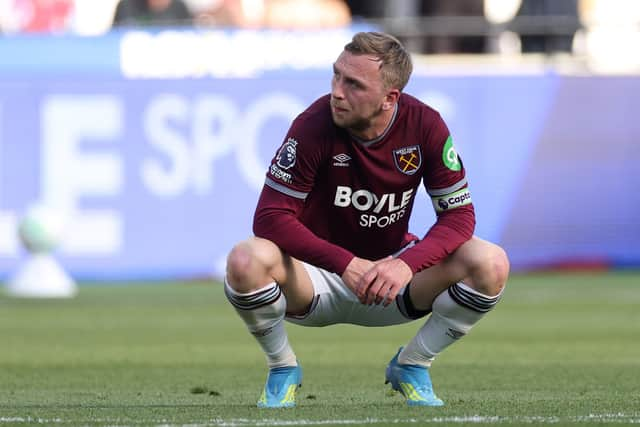

They are, clearly, not a lucky club – but at the top level of football, teams need to make their own luck to succeed. That’s something that they’ve been rather bad at in recent seasons. West Ham might be the best team to go down in years, but their failure is also a reflection of the mistakes being made at a club that simply aren’t set up to succeed in the modern game.
Why West Ham’s relegation is a reflection of their failure to recruit the right players
Back in January, Deloitte’s Football Money League estimated that West Ham were the 20th wealthiest club in world football, ahead of more than half of the clubs in the Premier League. That’s reflected in the amount of money they’ve spent in recent years: More than £420m on transfers in the last three season alone. The problem is that hardly any of that money was spent well.
Determining the worst piece of business they’ve been responsible for isn’t easy: Signing Max Kilman for £40m, perhaps? Spending £23m on Niclas Füllkrug when he was past 30 and already struggling with injuries? James Ward-Prowse, Luis Guilherme or Jean-Clair Todibo? None look like good deals in retrospect.
Every team makes mistakes in the transfer market, of course, but West Ham do it with alarming regularity, and not just in terms of the end product. Take the mid-season deal to sign Pablo from Portuguese side Gil Vicente, for instance: West Ham paid £20m to sign a player with a £12m release clause because they had already spent too much to be able to afford to pay the required amount up front. Now they’ve spent £8m more than necessary on a forward who didn’t score a single goal. Perhaps that’s the single worst piece of business they’ve done, then.
In the context of relentless recruitment failures, Nuno Espirito Santo did rather well to drag West Ham up to 39 points and make a fight of it. An ill-timed slump through the run-in ended up costing them their place in the top flight, but the blame can’t really be laid at the feet of the manager. David Sullivan and the board deserve the opprobrium instead.
West Ham’s poor recruitment is the near-inevitable result of years of utterly directionless executive decision making. The potted summary of the head of recruitment position over the last few seasons sums it all up rather neatly, and rather grimly.
In 2023, Sullivan installed Tim Steidten as technical director despite the fact that he had a completely different approach to that of manager David Moyes. The two promptly fell out and Moyes ended up leaving the club at the end of the season, only for Sullivan to sack Steidten the following January anyway.
Having seemingly learned that the manager and directors probably needed to be on the same page, or at least somewhere in the same book, Steidten’s replacement (who had a different job title but much the same role in the organisation) was Kyle Macaulay, handpicked by Graham Potter – but he lasted just nine months and was axed shortly after the manager despite a couple of success stories in last summer’s window such as El Hadji Malick Diouf and Mateus Fernandes, a brilliant midfielder who must be wondering how he’s been relegated twice in a row with different teams.
With Macaulay gone despite evidence that he might not be completely clueless, Sullivan decided that he knew better than anyone else and simply started handling transfers himself instead. It was Sullivan who was responsible for buying Pablo for nearly double his transfer value. To give him some credit, at least, fellow forward Taty Castellanos actually looked like a reasonably competent addition even if the six league goals he scored weren’t quite enough to keep West Ham afloat in the end.
Still, at a time when teams like Brighton, Brentford and Bournemouth continue to show the rest of the league that coherent, cohesive, analytics-driven recruitment can achieve remarkable things in the long run, West Ham chop and change directors without the faintest semblance of an overarching strategy and with no apparent reference to the kind of data which would have told them that, for example, Kilman and Ward-Prowse weren’t collectively worth £70m. Going from Steidten to Macaulay to Sullivan made it plain: There is no plan, just David Sullivan’s ego where a plan should go.
Will West Ham return to the Premier League next season?
Given that West Ham were, in spite of the best efforts of their owners, not all that bad in comparison to most teams which get relegated, and given that they are far richer than most teams in the Championship even before parachute payments are factored in, it’s tempting to assume that they will find it relatively easy to bounce back. It may not be quite so simple.
For starters, they are likely to lose their most important and most competent players in the coming weeks and months: Jarrod Bowen looked likely to leave anyway, Crysencio Summerville has several suitors, and the aforementioned Fernandes is wanted by sides such as Manchester United and PSG, whose interest would make a third consecutive relegation even more remarkable.
That’s the reality facing most clubs who get relegated, of course, but it will also put even more pressure on their recruitment this summer, and thus force the club to lean even more heavily on Sullivan. That’s not a promising position to be in based on the evidence we have to hand.
It also looks quite likely that the club will have to find a new head coach, too. Santo has not explicitly confirmed that he is leaving but refused to be drawn on the topic in media interviews after widespread stories suggested that he would quit if the club were relegated.
Yet again, that would bring Sullivan’s decision-making to the fore and his decisions surrounding managerial vacancies haven’t suggested much joined-up thinking is taking place there, either: In going from Mauricio Pellegrini to Moyes, then to Julen Lopetegui and Potter and eventually Santo, the club have appointed a succession of coaches with completely different styles, tactics and philosophies. There has been no consistency, no coherency, no apparent consideration as to how the squad and manager should line up with each other.
West Ham should have the resources to buy players that other Championship sides can’t afford and still have enough of a ‘big club’ reputation to persuade players to join them when they might otherwise be wary of signing for a second-tier side. But they also have a squad which will lose its best players and will struggle to offload their worst given that they are underperforming on high wages and long contracts.
Fail to offload enough of them and suddenly they may struggle to keep in line with the EFL’s new squad cost ratio rules, too, which would limit their ability to bring their otherwise beefier budget to bear. Throw in the seemingly high likelihood that they will buy the wrong players and appoint the wrong coach, and it’s easy to see the fail case.
Under the right management and with a little more clarity and less ago at boardroom level, West Ham would be in a good position to make their stay in the second tier nice and brief. But as Leicester City have handily demonstrated over the last couple of seasons, a combination of questionable executive leadership and consistently overpaying for the wrong players can lead to disaster.