
Will politics and price gouging be forgotten once the 2026 World Cup gets underway? FIFA certainly hopes so

Donald Trump, ICE and spiralling ticket prices have combined to keep World Cup fever at any all-time low - but will that change once the games begin?
A little under four years ago, on the eve of the deeply controversial 2022 World Cup in Qatar, FIFA president Gianni Infantino co-authored a letter with then secretary general Fatma Samoura begging that the participating teams “not allow football to be dragged into every ideological or political battle that exists.” It was a statement steeped in irony, but in many ways football’s governing body got their wish – once the matches started, politics seemed to take a back seat.
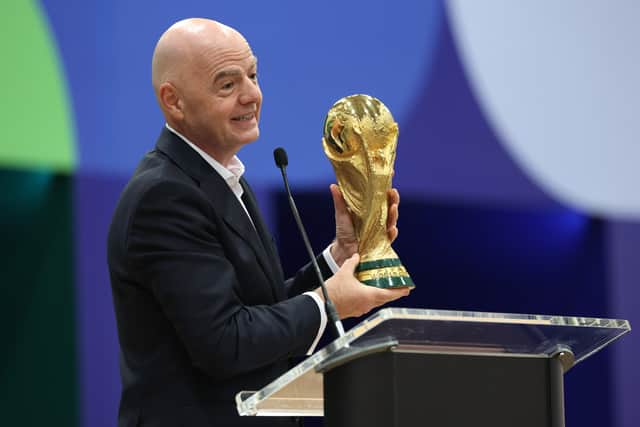

There were controversies to come, of course, not least over stadium staff forcibly removing pride flags and other symbols of support for the LGBTQ+ community from fans as they entered the grounds, but the hand-wringing over the host nation’s authoritarian regime and their treatment of construction workers seemed to end up as something of a footnote once the football itself got underway. It could easily be different this time around.
FIFA has allowed politics to sour the mood ahead of the 2026 World Cup
The 2026 World Cup is being hosted across three different countries, but you could be forgiven for forgetting that Canada and Mexico are involved. The shadow of the United States, and especially the presidency of Donald Trump, has loomed large over the build-up to the tournament.
FIFA’s desire for the World Cup to be a politically neutral event would have been optimistic even if Infantino hadn’t worked hard to insert himself into every possible political crevice, but in aligning himself so obsequiously with the Trump regime he has wilfully enabled a government that is doing everything possible to distract supporters from the sport and focus their attention on just about everything else.
For the most part, Qatar – and Russia before it – had the good sense to try to keep the less internationally acceptable elements of their ideology out of the spotlight. Trump’s America, however, has pushed them to the fore, with FIFA an eerily silent partner when they aren’t concocting peace prizes to hand out. The result is a World Cup which has inspired a distinct lack of enthusiasm and a great deal of concern.
It has, for example, been announced that ICE agents, in essence a secret police force who stand accused of the illegal detention, torture and extradition of countless people of colour on American soil, will be in attendance at matches, creating a source of justified fear for thousands of fans who might otherwise have travelled to support their teams.
The United States has also refused to allow the Iranian team to stay in America during the World Cup while they bomb their country, and you have to consider whether they will be permitted to cross the Mexican border without fuss when they travel to play their group stage games – all three of which are scheduled to take place in the US.
The Trump regime seems determined to imprint itself on the World Cup as firmly and as extensively as possible. The consequence is a climate of deep unease, with many fans around the world seemingly far less enthused about the 2026 edition of the tournament than might typically be the case.
A YouGov study suggests that 23% of the British public are less enthusiastic about this edition of the tournament than they were about Qatar 2022, while a similar survey in the Netherlands indicated that more than half of the Dutch public were “less excited” this year than they were ahead of previous editions. It’s a sentiment being echoed across much of the globe.
Meanwhile, ticket sales have been weak and hotels are struggling to sell beds. There are abundant indications that far fewer fans are travelling to the United States than were expected. There is a broad sense of apprehension about exactly what could happen in a World Cup policed by ICE and overseen by a president seemingly keen to flex his political muscle at every opportunity – and certainly no sense that Infantino or FIFA will have any power to rein Trump’s worst instincts in.
Greed and price gouging have taken their toll - but will we forget about all that once the football starts?
FIFA’s complicity in the palpable lack of enthusiasm about the 2026 World Cup goes beyond their cheerful support of the American government, of course. Their raw corporate greed, mirrored by so many companies and public institutions in the US who see the World Cup as a chance to line their pockets, has served to disincentivise supporters just as much as any political fears.
Vastly inflated ticket prices, extortionate accommodation and spiralling transport costs have put this tournament out of the reach of millions of supporters, with some tickets costs far higher than those pledged in the United States’ bid documents before they were awarded the hosting rights.
FIFA’s response to concerns of half-empty stadia has been limited, to say the least, with the attorney generals of New York and New Jersey opening a formal investigation into their ticketing practices amid allegations that they are dumping their extensive unsold inventory onto resale platforms and artificially inflating costs. At the time of writing, FIFA had not officially responded to the allegations.
The same pricing concerns exist in Canada and Mexico, too. With a week to go before the tournament, there were many unsold seats for group stage games in Toronto while fresh tickets were even being released – some at a cost of nearly $3,000 – for the opening match in the Estadio Azteca between Mexico and South Africa. Price gouging has not been a strictly American affair.
FIFA’s moral compass always points towards the money, but the 2026 World Cup has proven to be far more expensive for supporters than those which came before and that appears to have dampened enthusiasm for the event in the United States, as well.
YouGov polling also suggests that 54% of Americans have no interested whatsoever in the tournament while 59% said that they won’t watch any matches. That partially reflects football’s status as a minority sport in the US, but fails to reflect its immense growth in recent years, bolstered by the success of the MLS and in particular the presence of Lionel Messi at Inter Miami.
The surveys also suggested that pricing was a major factor in the lack of interest, with just 5% of Americans who said that they were ‘very interested’ in the World Cup prepared to pay over a thousand dollars to watch one of their country’s matches – and few tickets were made available at a lower price outside of a limited lottery of cheaper seats.
In Qatar, the football swiftly upstaged the grim political backdrop of the tournament. Perhaps the same will be true this year – maybe the sport will be of such high quality that the ticket prices are forgotten, and perhaps Trump and ICE behave themselves sufficiently well that they don’t end up making the biggest headlines of the summer. But not many fans seem willing to take that bet, and if the 2026 World Cup goes down as a failure of any kind, then FIFA will have a number of deeply difficult questions to answer.