
Will Iran play at the World Cup? Why they might miss out – and who could replace them

Could Iran pull out of the 2026 World Cup due to the war in the Middle East? And what might happen if they do?
As an increasingly controversial World Cup inches closer towards kick-off, one of the key questions in the build-up to the tournament has been whether Iran will take part as a result of the war that has broken out between the Middle Eastern country and the United States and Israel.
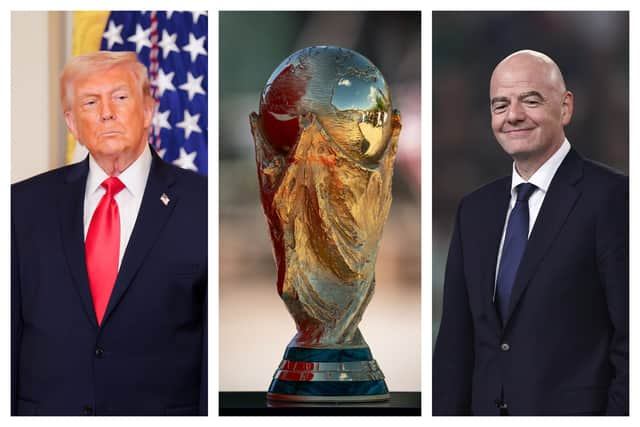

The conflict began on 28 February after the US, one of three co-hosts of the 2026 World Cup along with Canada and Mexico, launched attacks on targets inside Iran. The war continues, with faltering peace negotiations showing little sign of reaching a positive conclusion. So will Iran, who are scheduled to play all three of their group stage matches in the US, be involved? And if they are forced to drop out, who might take their place?
Will Iran play in the 2026 World Cup?
Iran were drawn in Group G of the World Cup, alongside Belgium, Egypt and New Zealand, who are set to be their first opponents on 15 June at the SoFi Stadium in Los Angeles. The same venue is also expected to host their game against Belgium before they travel to Seattle for their final group stage game against Egypt.
The Iranian team’s participation has been thrown into increasing question, however, following the US-Israeli attacks on their country. FIFA president Gianni Infantino has insisted on several occasions that Iran will participate as planned – but with no diplomatic solution to the conflict in sight, the question will remain.
The Iranian Minister of Sports and Youth, Ahmad Donyamali, said in March that Iran would not be involved as a result of the war, saying that “under no circumstances do we have the appropriate conditions to participate in the World Cup.” Since then, however, the president of the Iranian FA has insisted that their team will be involved, and the Iranian government has yet to institute any policy suggesting that they will pull out.
Among the many questions is whether the American government might prevent Iranian players, officials and support staff from entering the country. Secretary of State Marco Rubio said on Thursday evening that the team would be allowed to enter the country and play their matches, but added that anyone in the travelling party deemed to have ties with the Iranian Revolutionary Guard Corps (IRGC) would not be allowed in.
“Nothing from the U.S. has told them they can’t come,” Rubio told the press. “If they decide not to come on their own, it’s because they decided not to come… What they can’t bring is a bunch of IRGC. terrorists into our country and pretend that they are journalists and athletic trainers.”
As it stands, FIFA wants Iran to play and the Trump administration has yet to close the door, but isn’t exactly extending a warm welcome – and much may yet depend on the outcome of peace talks between the US, Israel and Iran over the coming weeks. With the World Cup less than 50 days away and Iran’s side expected on American soil in just over a month, it’s extremely unclear how it will all play out.
Who could replace Iran if they withdraw from the World Cup?
If Iran are unable or unwilling to play, then FIFA has no set regulations in place which determine who would fill their shoes at the tournament. No team has withdrawn from the World Cup after qualifying since 1950, when Scotland, India and Turkey pulled out. On that occasion, no replacement teams were named, although that doesn’t necessarily set a precedent for the modern era.
It is possible that Iran’s fixtures would be nullified, with Group G either becoming a three-team group or all of their fixtures being recorded as 3-0 walkovers for their opponents. FIFA is keen to avoid that scenario, but it remains a possibility given the absence of a precedent for determining how a team might be replaced. Nothing in FIFA’s rules for the World Cup provides guidance.
The structure of the Asian World Cup qualifiers don’t create a clear ‘runner-up’ who can be promoted in Iran’s place if they were to withdraw. The best-placed team in the fourth round group stage of that tournament who failed to qualify was the United Arab Emirates – they would perhaps be a politically straightforward inclusion as an American ally, but other countries progressed further through the intercontinental play-off system.
Bolivia and Jamaica both lost in the finals of their intercontinental play-offs, meaning that they are arguably the two teams from outside of Europe who came closest to qualification without making it. How FIFA might determine which one deserved the spot more is unclear, and in any case the European sides who lost their play-off finals would surely have an equal claim.
One European team who seem very unlikely to take Iran’s place is Italy, who failed to qualify for a third consecutive World Cup when they were beaten by Bosnia & Herzegovina on penalties. The possibility of Italy entering the World Cup was raised by US envoy Paolo Zampolli, an Italian-American former modelling agent who is close friends with Donald Trump, who told The Financial Times that he had asked the President to replace Iran with Italy – not a gift that should be within the American government’s power to give, but in any case one that both FIFA and the Italian government have pushed back on.
The Italian Sports Minister, Andrea Abodi, told reporters that Italy’s inclusion was “not possible, and… not appropriate,” adding that “qualification [comes] on the pitch.” FIFA has further insisted that it has no such plans to replace Iran with Italy.
If FIFA has any contingency plans in place, it is keeping them close to its chest. As it stands, they expect Iran to play and do not appear to have decided what would happen if they do not. If they were to withdraw shortly before the tournament, it may in any case be exceptionally difficult for a potential replacement to prepare in time, or to organise transportation and training facilities.
As it stands, the outcome of the situation is unclear and may hinge on diplomatic efforts to bring peace to the Middle East over the coming weeks – but if Iran do withdraw, it may be impossible, on a practical level, to replace them with another team.