
Lewis Hall and Trent Alexander-Arnold gave England a glimpse of a bright future - but no more than that


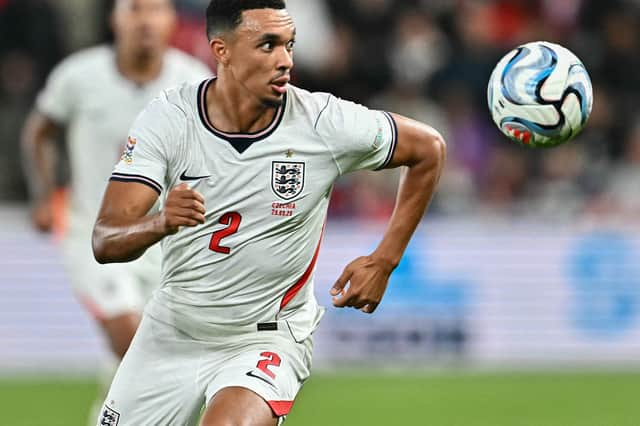
Trent Alexander-Arnold and Lewis Hall were excellent for England against Czechia - but proof of concept is still required.
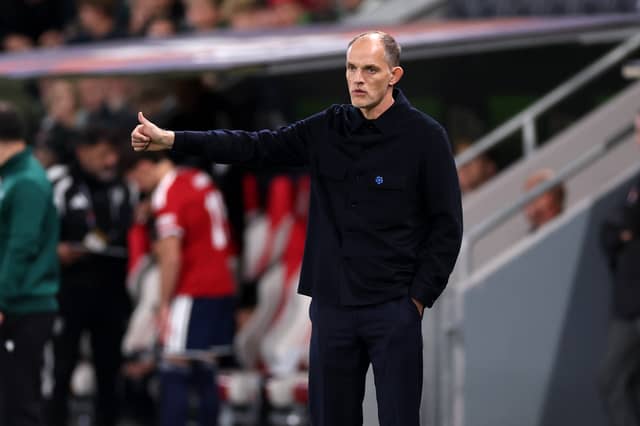
England’s comfortable win over Czechia on Tuesday evening didn’t provided the Three Lions, or their head coach Thomas Tuchel, with an excessive number of teachable moments.
Once the home side went down to 10 men, England were able to devolve their Nations League tie into attack versus defence. They controlled the game and any attempt to determine the influence of the players who came into the side is skewed by the easy control they were able to exert over numerically inferior opposition. For the first 15 minutes, it looked like England might get a meaningful test in Prague. They did not.
The lop-sided nature of the encounter has to be factored in when listening to the gushing praise for Trent Alexander-Arnold and Lewis Hall, who offered English supporters a glimpse of a team with wing-backs who could provide the width and verticality so often lacking under both Tuchel and Gareth Southgate. So how much did we really learn – and did we really see enough evidence to suggest that Hall and Alexander-Arnold should be staples of the squad going forward?
What did England really learn about Trent Alexander-Arnold?
The match in Prague could have gone very differently if it wasn’t for one player, England’s undoubted man of the match: Pavel Šulc, who generously missed two relatively straightforward chances before getting himself sent off for a high, studs-up tackle on Elliot Anderson. After the red card, it was plain sailing. Prior to that, it was all rather sloppy, especially at the back.
That scruffy opening quarter of an hour served as further evidence that England should probably abandon the idea of becoming a team that plays it out from the back under the high press, but also provided Tuchel with at least one more reason to worry about Alexander-Arnold, who was one of several English players who gave the ball away needlessly in the opening exchanges.
Last May, Tuchel explained the absence of the Real Madrid right-back from one of his line-ups by pointedly criticising his defensive work. The notion that Alexander-Arnold isn’t at his best at the back is hardly new, but it serves to explain the head coach’s reservations.
“Sometimes he relies heavily on his offensive contributions, and gives not so much emphasis on the defensive discipline and effort,” Tuchel told the media at the time. "This major impact that he had for Liverpool over so many years, if he wants to have this impact in the English national team, then he has to take the defensive part very seriously.
“[In] tournament football, the one defensive error, the one moment where you are not 100 per cent awake, can be decisive, can be the moment where you pack your suitcases and go home.”
And there he was, making that one – in this case unpunished – mistake right at the beginning of the game. If he wanted to change Tuchel’s mind, he didn’t get off to the best start. This was not a blemish-free evening, even if the error wasn’t one which proved to be at all costly.
What Alexander-Arnold did provide, of course, was the delivery for Anthony Gordon’s opener. It wasn’t quite the perfect cross, a fraction behind a target who was compelled to contort himself to keep control of the header, but it served as a reminder of the former Liverpool full-back’s talents – not least his ability to come up with crosses that perhaps only David Beckham could otherwise manage in the modern era of English football.
The assist was one of three shooting chances which Alexander-Arnold created as he drove England forward with the kind of dynamism which Jarell Quansah, who operated in the right-back role against Spain, simply doesn’t have in his armoury. The attacking intent from out wide which England fans have craved came in spades. There were caveats beyond that misguided pass in the early stages, however.
The obvious one is that England were playing against a side who went deep into their shell after losing Šulc, and that meant that Alexander-Arnold was given license to keep attacking for long periods. It also meant that his defensive mettle was scarcely tested. Given that he lost all three of his one-on-one duels, that may not have been a bad thing for him.
Before the clamouring for regular starts for Alexander-Arnold grows too loud, it would be worth seeing how he fares at the back, against a side with more attacking quality down their left wing and who aren’t down to 10 men.
On Tuesday he earned the right to a long, lingering look from Tuchel over the next two games of this extended international break, but it would be foolhardy to imagine that he dispelled all of the coach’s doubts with one stroke of his right boot. He has to tighten up closer to his own goal if he wants to displace Reece James in the long run, for all of his undoubted excellence at the business end of the field.
Lewis Hall made his case – but Tuchel needs proof that his changes worked
Did we learn anything about Alexander-Arnold that we didn’t already know? Not really. We probably didn’t learn much about James Trafford in goal, either, or Myles Lewis-Skelly, Rio Ngumoha or Alex Scott, although the latter two did supply the game’s closing passages with some admirable energy on debut.
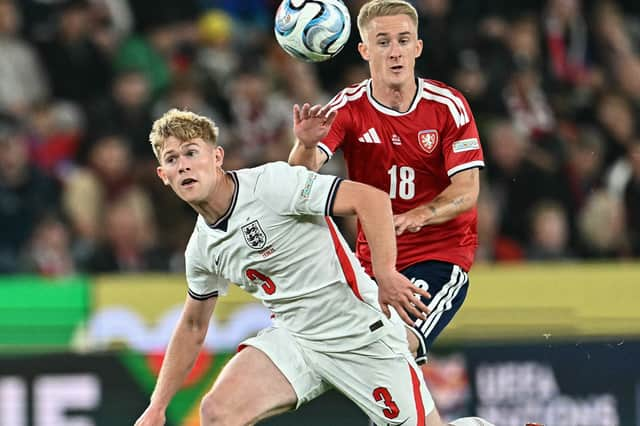
We did, perhaps, learn that Lewis Hall offers an awful lot going forward as well, even if his final ball didn’t find the mark all that often. Where Nico O’Reilly – who has generally played well for England - tended to get bogged down in midfield against Spain, coming inside onto his stronger right foot, Hall offered width, verticality and a direct attacking threat down the left flank. He, like his colleague on the opposite wing, demanded a longer look.
Hall’s defensive work was also quite solid – he won three of his five one-on-one battles, made several key interceptions and clearances, and was surprisingly useful in the air on a few occasions. His performance might not have earned the headlines that Alexander-Arnold’s did and nor did it have a genuine highlight-reel moment, but it was arguably a more well-rounded outing.
Between Hall and Gordon, who spent much of the Spain match stuck in deeper positions but was England’s most advanced attacking player by average position in Prague, the Three Lions looked more direct, more dangerous, and more balanced in attack. Gordon appears to be on a one-man mission to reshape England into a more aggressive, vertical team since his move to Barcelona, and in concert with his former club team-mate provided a fine advertisement for his vision of the future.
The victory against Czechia was not, however, a match which provided much proof of any particular concept, be it Alexander-Arnold’s primacy at right-back or the value of Hall and Gordon linking up down the left. This was a game which was played on easy mode for an hour.
The trip to Croatia on Saturday might provide a more useful testing ground for some of these hypotheses, as might Czechia’s return trip to Wembley a few days later. For now, all that we really know for sure is that we know nothing. Both Socrates and Enzo Maresca might approve.